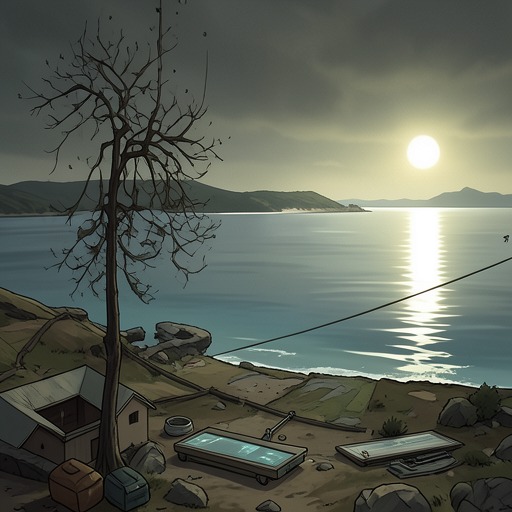
Ikaria’s exceptional longevity
Cartes Postales from GreeceIkaria’s exceptional longevity is presented both as a communal mystery and, through Ariadne, as an intensely personal consequence of keeping faith with the dead. The island’s reputation invites explanations in diet, hot springs, and daily habits, but the novel leaves the cause open; Ariadne’s own longevity has a clearer source in the duty she has chosen to preserve.
An island associated with long life
Ariadne describes the island, named after Icarus, as a place where people have always lived long lives. She recounts several explanations offered over time: in Daedalus’s day people ate little except fish; later came the discovery of hot, radioactive springs; then people ate organic food; and in the present they followed their own idiosyncratic timetable and experienced little stress. These are possibilities, not a settled account. Ariadne leaves the general mystery unresolved, asking in effect why some people live so long when no one can know for certain.
The uncertainty gives the island’s reputation a distinctive place in the novel. It is not reduced to a single natural resource or lifestyle formula. The explanations accumulate across generations, each tied to a different way of living, while the question of longevity remains larger than any one of them.
Ariadne’s promise to Icarus
Ariadne distinguishes her own survival from the islanders’ unexplained longevity. She says she knows why she is still alive: she must be. Before Daedalus departed by boat, he left her with the duty of caring for Icarus’s memory. Ariadne continues to visit Icarus every day, keeping the grave’s location secret so that tourists will not trample it. Her longevity is thus bound to an ongoing act of fidelity rather than to a claimed medical or environmental cause.
She has also continued to watch for a sign that her task might be complete. Each time she sees a butterfly, she wonders whether it marks the flight of Icarus’s soul, but she cannot be sure and therefore carries on. The promise does not resolve into a single moment of release: uncertainty itself keeps the daily observance in place.
Longevity, myth, and mortality
Ariadne’s account blurs the boundary between an island’s remembered history and legend. She insists that events eventually treated as myth were real, including what she calls the first plane crash, which she locates over the island; she also presents a feather from Icarus’s wings to those gathered around her. The extraordinary longevity attributed to Ikaria belongs to this same narrative space, where mythic figures and historical time are brought into close proximity.
The narrator frames that proximity against the ordinary visibility of death in Greece: notices on lamp posts, village cemeteries, and roadside memorials. On Ikaria, however, hardship and mortality do not simply produce resignation. During a religious festival, the narrator joins a slowly circling dance that gathers speed, and describes drinking, feasting, and dancing as forms of defiance. In this setting, long life is not only a matter of how many years a person reaches; it is also set against the insistence on living fully among others.
The island as lived experience
The narrator’s approach to Greece begins with postcards arranged into a bright blue-and-white mosaic, images that provoke a longing for places never visited. Their apparent promise raises the question of whether the light and beauty they depict are real or exaggerated. Ikaria eventually becomes more than an imagined destination: the narrator stays above an empty shop in Evdilos, swims in a hot spring, talks with strangers, and returns to meet Ariadne for coffee in the sunshine.
That lived encounter gives the island’s longevity motif personal force without turning it into a guaranteed cure or a simple explanation for the narrator’s recovery. Ariadne suggests that time eventually healed Daedalus’s grief and that it is working for the narrator, too. By the end of the visit, the narrator wants to live into old age rather than not live at all. Ikaria’s exceptional longevity therefore functions as both a question about the conditions of long life and a setting in which the desire to keep living can return.